Knowledge About Taekwondo
Here you'll find everything you need to know about taekwondo. Just select a category to explore techniques, terms, and background information in detail.
The Basics
When people hear the word “taekwondo” today, many immediately think of the spectacular, lightning-fast kicks seen at the Olympic Games or of colorful mats and electronic protective vests. That’s the modern, athletic side of it.
But beneath the glittering surface of modern competitive sports lies traditional taekwondo—a centuries-old system of self-defense, character development, and physical training.
Etymology: A Name as a Guide
To understand traditional taekwondo, let's look at the three syllables that make up the word. Each syllable carries a deep meaning in Korean.
TAE, KWON & DO
Tae (태): The Power of the Legs. It represents the enormous variety of leg techniques that make the leg the primary weapon.
Kwon (권): The Power of the Fist. Refers to all hand and arm techniques used for control at close range.
Do (도): The spiritual path. The philosophical component that shapes character and teaches discipline and respect.
Who is it intended for?
Children: Learn discipline, coordination, and respectful behavior in a playful way to build healthy self-confidence.
Adults: Find the perfect balance to everyday life with a full-body workout that clears your mind.
Seniors: Controlled movements promote balance and breathing, helping you stay mobile and mentally alert well into old age.
Tradition vs. Olympic Sport
While the sport aims for victory in competition and quick points on electronic vests, the traditional form focuses on real-life self-defense and maintaining good health.
Focus & Reality
Training: In the traditional system, maximum power and stability are key to being able to stop an attack in an emergency.
Scenarios: We train for real-world challenges—defending against unpredictable situations or multiple attackers is an integral part of our program.
Mudo – A Philosophy of Life
Mudo describes the “path of martial arts.” We view life’s daily challenges as opportunities for growth. The discipline and clarity we gain from training are our tools for confidently navigating everyday life.
Stages of Development
Physical: Strength, flexibility, and endurance.
Mental: Concentration and mental strength.
Ethical: Courtesy, integrity, and loyalty.
Summary of the Basics
Traditional taekwondo is a holistic system that trains the body to achieve the highest levels of precision and self-defense. At the same time, it trains the mind to ensure that these acquired skills are always used judiciously and exclusively for self-defense.
The traditional taekwondo practitioner is like a precious sword: forged through rigorous training and securely sheathed by the “Do” (the philosophy). The goal is to attain the wisdom never to have to draw that sharp sword.
The Story – From the Three Kingdoms to World Art
The history of taekwondo is as old as Korea itself. It has been shaped by the need to defend against constant invasions and the desire to refine the human spirit through physical discipline. We divide this journey into four major eras.
The Era of the Three Kingdoms
In the early period (approx. 57 B.C. – 668 A.D.), primitive forms of unarmed combat developed in Koguryo, Paekche, and Silla as a means of protection against invaders and wild animals.
Koguryo & Silla
While murals in Koguryo already attest to systematic techniques, Silla founded the Hwarang (Flower Boys). This elite unit was trained in martial arts, philosophy, and ethics; their moral values continue to form the foundation of our dojang to this day.
Koryo- and Joseon-Dynasty (918 – 1910)
During the Koryo period, the martial art (Subakgi) became a popular sport. Under the Joseon Dynasty, Confucianism shifted the focus toward scholarship, but the textbook Muye Dobo Tongji ensured the preservation of the techniques. Taekkyon, which emphasized footwork, also originated during this period.
Occupation & A New Beginning (1910–1945)
During the Japanese occupation, Korean culture was suppressed and martial arts were banned. They survived in secret. After 1945, masters returned from abroad and founded the “Original Five Kwans,” which laid the foundation for today’s system.
The Origin of the Name & The Schism
On April 11, 1955, the name “Taekwondo” was officially adopted, largely thanks to the efforts of General Choi Hong-hi. Political tensions later led to a split into two world federations:
ITF (1966): Focus on the theory of power and tul (forms).
WTF / World Taekwondo (1973): Headquarters at the Kukkiwon, focus on developing taekwondo into a global Olympic sport.
Why “Traditional”?
Today, traditional schools teach techniques for genuine self-defense and character building rather than for scoring points. We preserve the ancient forms and philosophical roots of the Hwarang knights.
Summary of the history
Taekwondo is a story of survival. When we stand in the dojang today, we carry within us the legacy of the resistance fighters and pioneers. Every bow and every kick is a tribute to this journey spanning millennia.
Philosophy & the “Do” – The Spiritual Path
The term “Do” (도) describes a path to self-awareness and wisdom. In traditional Taekwondo, this means that every time you enter the dojang, you are not only working on your kicks, but also on your character.
The 10 Virtues (YU Taekwondo)
According to Dr. Andreas Held’s system, these ten values serve as our students’ moral compass—both on the mat and in everyday life.
1. Respect
Respect and appreciation for others. Rituals such as bowing demonstrate this respect, which should be completely free of paralyzing fear.
2. Tidiness
A clean, organized environment—such as lining up in rows according to belt rank—creates an optimal learning atmosphere and fosters inner order.
3. Discipline
Self-regulated behavior. Putting aside immediate needs ensures steady progress in learning and helps prevent injuries during training.
4. Patience
The ability to practice consistently. Technique and maturity don't develop overnight; they are honed through countless repetitions.
5. Courage
Overcoming fear and insecurity—whether during a breaking test, a demonstration, or by standing up for one’s own needs.
6. Gratitude
An appreciation for the privilege of being able to train, as well as for the valuable support provided by parents, teachers, and one’s own body.
7. Fairness
Impartial and equal treatment. In our uniform dobok, we always treat one another as equals, regardless of background, age, or gender.
8. Wisdom
Knowledge and life experience gained over time. Wise Taekwondo practitioners exemplify these virtues and pass on the tradition to others.
9. Kindness
Kindness and friendliness. It means forgiving mistakes, encouraging strengths, and always fostering a constructive atmosphere.
10. Spirit of Unity
A strong sense of community. Every member is valued; we help one another unconditionally and exclude no one.
Philosophical Roots
Confucianism: Order, loyalty, and respect for elders foster harmony through clearly defined roles.
Taoism: The balance of Um and Yang. We seek balance between hard and soft, attack and defense.
Buddhism & Zen: Mindfulness and “emptiness” (mushin), in which the body reacts instinctively and without distracting thoughts.
The Oath & Meditation
I will abide by the principles.
I will respect my instructor and those in authority.
I will never misuse Taekwondo.
I will stand up for freedom and justice.
Mok-so (Silence)
The training begins with a period of silence. Deep diaphragmatic breathing lowers the heart rate and channels the Ki for explosive techniques. It serves as the bridge between body and mind.
Traditional vs. Olympic
Traditional: Focus on the individual's physical and mental development.
Olympic: Focus on competition and scoring.
The Goal: The Peaceful Warrior
The ultimate goal is to become a person who no longer needs to fight. Anyone who de-escalates a conflict through self-mastery has reached the highest level of martial arts—victory without a fight.
Dojang & Etiquette – The Place and Conduct
Anyone visiting a traditional taekwondo school for the first time will immediately notice a special atmosphere. There is a blend of focused silence, respect, and discipline. This environment serves to calm the mind and direct one’s focus to what is essential.
The Dojang: More Than Just a Room
The word dojang (도장) means “a place where one studies the way.” In a traditional dojang, students learn to feel the techniques rather than simply checking them visually in the mirror. National flags and association emblems serve as constant reminders of the art’s roots and its global community.
Cleanliness and Order
The cleanliness of the dojang is an expression of mutual respect and appreciation for the martial art. A well-maintained environment forms the foundation for inner discipline. In the philosophy of Taekwondo, outward clarity corresponds directly to the inner attitude of the practitioners.
The Etiquette (Ye-Ui)
Mutual respect is your lifeline in a martial art that involves dangerous techniques. Etiquette ensures that training is safe and harmonious.
Bowing & Hierarchy
The bow (Kyong-Ye) is a gesture of respect towards the flags, the teacher and one’s partner. There is a clear hierarchy in the room: Sunbae (advanced students) act as role models, whilst Hoobae (beginners) learn from their behaviour.
The Dobok: The Garment of Purity
The white dobok symbolises purity. Its cut represents the elements of heaven (V-neck), earth (trousers) and humanity (belt).
Caring for your clothes
A taekwondo practitioner should always be well-groomed. The dobok must be clean and neatly folded. Removing jewellery is for safety reasons and ensures that everyone in the dojang is equal – only hard work and character count.
The Belt (Ti): A Reflection of Experience
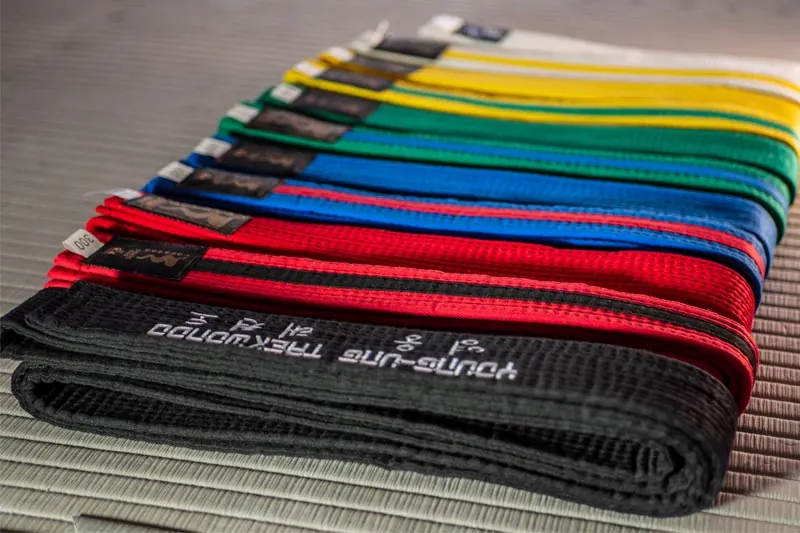
The colours reflect the process of maturation: from white (a blank slate) through green (growth) to black (maturity). A traditional belt is never washed, as it symbolically embodies the experience one has accumulated.
General Rules of Conduct
Punctuality: Protects the group’s energy flow.
Calm: Focus on the teacher and your own movements.
Correct sitting posture: Sitting upright on your heels demonstrates self-discipline.
Hygiene: Short nails are compulsory to prevent injuries.
Fazit zur Etikette
Die Etikette ist der „sichere Hafen“ für intensives Training. Wer lernt, sich im Dojang diszipliniert zu verhalten, wird diese Stärke und den Respekt fast automatisch in seinen Alltag und Beruf weitertragen.
Him Ui Wolli – The Physics of Combat
In traditional taekwondo, there is no such thing as ‘magical’ energy; rather, it is the intelligent application of biomechanics and physics. The theory of power comprises six factors, which must work in perfect harmony to achieve maximum effect.
Reaction Time & Concentration
Reactive Force (Bandong Ryok): In accordance with Newton’s third law, we utilise the counter-movement – the explosive retraction of the free fist towards the hip – to stabilise the torso and massively increase the striking speed.
Concentration (Jip Joong): Force is focused on tiny areas (P = F/A). We use the knuckles (Ap-Joomuk), the edge of the hand (Sonal) or the ball of the foot (Ap-Chuk) to concentrate the body’s entire strength onto a single point.
Balance & Breath Control
Balance (Kyun Hyung): A stable stance (static) or control whilst turning (dynamic) ensures that the force generated from the ground can flow unimpeded towards the target.
Breath control (Ho Heup): Exhaling sharply at the moment of impact stabilises the torso through muscle compression (‘internal armour’) and supports the explosive contraction. The battle cry (Kihap) audibly channels these energies.
Volume & Speed
Mass (Jillyang): Power originates in the feet and is accelerated by hip rotation. The sine wave also utilises gravity to drive the entire body weight into the impact.
Speed (Sok Do): As speed squared is a factor in the energy formula (E = ½ mv2), acceleration is the most important factor. Maximum speed is achieved through a relaxed posture, which only becomes firm at the moment of impact (‘snap’).
Rotation & Combination
The Snap: A 180-degree rotation of the fist or foot just before impact creates a drill effect, prevents slipping and stabilises the joints through tendon tension.
Example of a side kick: This is where the perfect interplay comes into play: a stable anchor (balance), hip rotation (mass), striking with the heel (concentration) and a sharp exhalation (breathing) – all in a fraction of a second.
Conclusion on the theory of force
The theory of force is applied physics. Understanding these biomechanical principles makes training both efficient and fascinating, as movements are not merely learnt by heart but understood in terms of their scientific logic.
Stances & Foundations (Seogi) – The Roots of Strength
Beginners often underestimate the importance of stances and immediately set their sights on spectacular kicks. A grand master, however, can often recognise a student’s quality simply by the way they stand. In Taekwondo, stances form the starting and ending points of every movement and serve to stabilise the body, generate energy and shift the centre of gravity.
Why are the stances so important?
Balance (Chung-Yong): A correct stance anchors you to the ground and prevents you from falling when kicking or when subjected to external forces.
Power transfer: The legs and hips generate the power; the stance acts as a launch pad. Without the correct foot position, the energy is wasted.
Mobility: Only a technically flawless stance enables lightning-fast changes of direction and controlled evasive manoeuvres.
Basic stances in detail
Moa-, Narani- & Ap-seogi
From the closed attention stance, through the parallel stance (Junbi), to the walking stance (Ap-seogi) – these stances form the dynamic foundation for concentration and swift action.
Chongul-seogi (Forward Stance)
About 1.5 to 2 shoulder-widths long, with the front leg bent and the back leg straight. It provides maximum stability and forward power for powerful punches.
Special & Defensive Stances
Hugul-seogi (L-Stance)
70 per cent of the weight is on the back leg. This classic defensive stance allows for immediate counter-kicks with the front leg, which is off the ground.
Kima- & Ditpal-seogi
The riding stance (Kima-seogi) strengthens the leg muscles and isolates hip rotation. The tiger stance (Ditpal-seogi) is the most explosive foundation for lightning-fast jumps and kicks.
Orientation & Transitions
Precision: The entire sole of the foot remains in contact with the ground. Applying gentle outward pressure with the knees creates the necessary arch tension for a springy, stable stance.
Dynamics: Transitions are controlled by the hips (Dan-Jun). Head height remains constant whilst gliding, so as not to compromise the centre of gravity.
Training tips & conclusion
Stances can be perfected through isometric holding in everyday life (e.g. Kima-seogi), which builds mental strength and fundamental power. They form the backbone of the martial art and give the Taekwondo practitioner the necessary composure and calm to handle any situation.
Hand Techniques – More Than Just Punching
In traditional Taekwondo, we do not view the arm as a rigid object, but rather as a chain of joints and levers capable of delivering various "weapons" to the target. A Taekwondo master possesses an arsenal of hand techniques that goes far beyond that of a boxer. We fundamentally distinguish between thrusting (Jireugi), striking (Chigi), piercing (Tulgi), and blocking (Makki).
The Fist (Joomuk) – The Classic
The fist is the most frequently used tool. The way the fingers are curled determines both effectiveness and safety.
Fist Variations & Rotation
Ap-Joomuk: The standard fist. Only the front two knuckles make contact while keeping the wrist straight.
Dung-Joomuk: The back of the fist is used in a whip-like motion against the temple or nose.
Me-Joomuk: The hammer edge for secure attacks on the collarbone.
The Rotation: The 180-degree twist of the forearm just before impact creates the necessary boring/corkscrew effect.
The Open Hand & Special Tools
Open hands allow for precise strikes against soft tissue and are often faster than fist thrusts.
Sonal (Knife Hand): The knife hand against the carotid artery or ribs.
Batangson (Palm Heel): One of the most stable tools for hard strikes against the chin.
Pyeonsonkeut: A fingertip thrust aimed exclusively at sensitive soft tissue.
Palkup (Elbow): The hardest point of the body for extreme close-quarters combat.
The Art of Defense (Makki)
A block is never passive. The goal is to strike the attacking arm so painfully that no second attack follows – a block is simultaneously a strike.
Levels & Principles
Arae-Makki: Low block to protect the lower body.
Momtong-Makki: Middle block to protect the torso.
Olgul-Makki: High block that deflects attacks over the head at a 45-degree angle.
Deflection: Techniques like Hechy-makki utilize the opponent's power by gently redirecting it.
Anatomy & Training
Shoulder & Back: A strike begins in the legs and is channeled through the shoulder blades. The latissimus provides the fast pull-back.
Gibon Yonsup: Basic training to automate the paths of motion.
Conditioning: Training on a makiwara or punching bag to increase bone density.
Saho-Jireugi: Four-direction punch to train orientation and spatial awareness.
Conclusion on Hand Techniques
The study of hand positions allows for adaptation to any distance. Those who master this variety utilize the full potential of the human body for self-defense.
The Art of Kicking (Chagi) – The Trademark
Anyone training in traditional Taekwondo transforms their legs into "long swords." However, a good kick is far more than just swinging the leg upward; it is a complex interplay of flexibility, timing, balance, and proper biomechanics.
The Three Phases of a Kick
Every kick follows a precise three-phase model to ensure maximum efficiency and safety:
1. Chambering: The knee is explosively pulled upward to protect the upper body and disguise the kick until the very last moment.
2. Execution: The leg snaps out to the target while the hip drives body mass behind the foot.
3. Snapping/Retraction: The foot is pulled back instantly to prevent counters and secure balance.
The Striking Surfaces of the Foot
Ap-chuk (Ball of the foot): Primary surface for the front kick; toes are pulled back for a hard impact.
Dwichook (Heel): The hardest tool for back or downward kicks – acts like a sledgehammer.
Balkal (Outer edge of the foot): The focal point of the side kick for maximum structural stability.
Baldung (Instep): In the traditional realm, primarily used for strikes to soft tissue or ribs.
The Fundamental Kicks
Ap-chagi (Front Kick)
Fast and direct like a piston. Aims for the shin, lower abdomen, or solar plexus.
Yop-chagi (Side Kick)
Most powerful kick; standing foot pivots 180 degrees while the heel pierces the target.
Dollyo-chagi & Dwit-chagi
Rotation is key. The roundhouse kick utilizes a circular path, while the back kick engages the massive gluteal muscles.
Mastery & Precision
Hips & Supporting Leg: A good kick originates from the ground. The supporting leg acts as an anchor, the hip as the transmission of power.
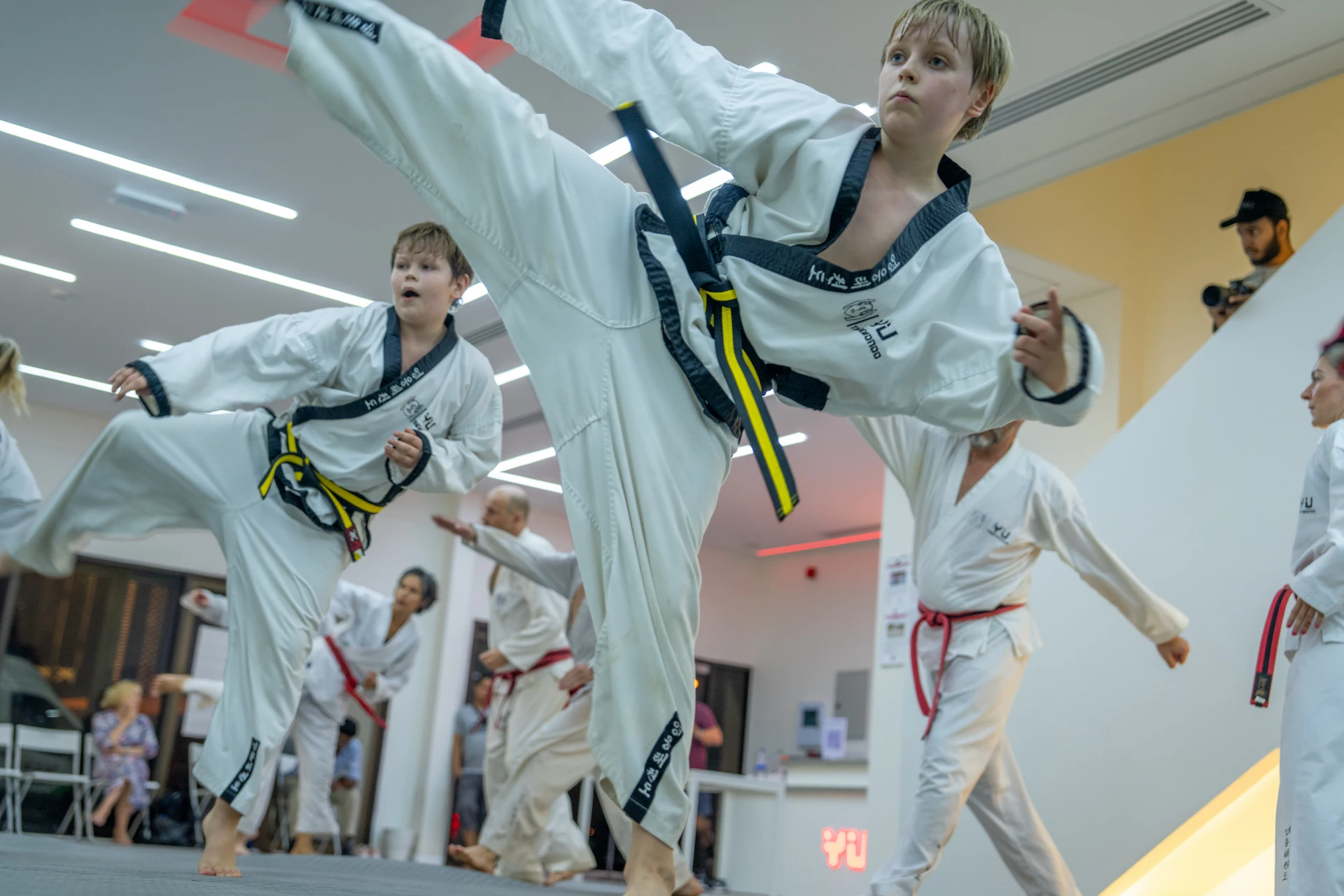
Precision over Height: Low kicks disrupt the opponent's balance. High kicks serve as the ultimate test of body control.
Advanced: Techniques such as spinning hook kicks or jumping kicks expand the repertoire once a stable foundation is built.
Training Tips for the Legs
Mastery requires systematic stretching (static & dynamic), slow-motion training for deep stabilizing muscles, and isolated wall training for perfect hip rotation.
Summary of Leg Techniques
Leg techniques are the trademark of Taekwondo. They demand discipline and offer a defensive capacity that bridges distances before the opponent even recognizes the threat.
Partner Exercises & Self-Defense (Hosinsul)
While many people today equate Taekwondo with athletic competition (sparring), the original goal of partner exercises is pure self-defense. In a real emergency situation, there are no weight classes, no referees, and no points; the sole objective is to get out of a situation unharmed.
Pre-Arranged Sparring (Taeryon)
Before a student learns to defend themselves freely, they must understand distance and timing within a controlled framework. This is achieved through step-sparring.
Ilbo-Taeryon (One-Step Sparring)
This is the most important partner exercise in traditional training. The defender learns to react to a fixed, predetermined attack with precise evasion, blocking, and immediate counter-attacks. Utmost discipline is required, as every technique is stopped just short of the body.
Other forms such as Ibo-Taeryon (Two-Step) and Sambo-Taeryon (Three-Step) automate movement sequences in forward and backward motions.
Hosinsul: Releasing from Grabs
A core aspect is escaping from grips on the wrist, lapel, or from behind. We utilize physical laws of leverage instead of brute force.
The Weak Point: Joints are rotated against the gap between the opponent's thumb and fingers.
The Hips: The escape is generated by moving the entire body.
Shock Techniques: Striking impulses, such as kicks to the shin, disrupt the opponent's concentration prior to the release.
Locks and Throws (Kuk-Ki)
At close range, strikes often become inefficient. Joint locks—the hyperextension or twisting of the wrist and elbow—allow for controlled restraint of the opponent. Throws additionally help disrupt the opponent's center of gravity and create space for escape.
Vital Points (Kupso)
Advanced students learn about areas where nerve pathways run close to the surface. Targets like the solar plexus make it possible to compel an opponent to cooperate without causing permanent injury. This requires a high level of moral maturity.
The Art of Falling (Nakbub)
Breakfalling teaches how to absorb impact energy through rolling or targeted slapping with the arms, protecting the head and organs during a fall.
Psychology of Defense
Hosinsul begins before any physical contact, through situational awareness and de-escalation. Only when a fight becomes unavoidable is the defense executed explosively and resolutely.
Summary of Partner Exercises
The study of Hosinsul makes Taekwondo "real." It imparts adaptability and mental fortitude, ensuring the student remains capable of taking action in an emergency without having to rely on blind aggression.
Forms (Tul/Poomsae/Hyong) – The Battle Against Oneself
A form is a set sequence of movements against imaginary attackers, comparable to a precise choreography where every movement has a specific meaning. Depending on the tradition, these sequences are referred to as Hyong, Tul, or Poomsae, but all pursue the goal of technical perfection and the harmony of body and mind.
Why do we perform forms?
The form offers advantages that go beyond sparring: It programs muscle memory through technical purity and challenges balance through complex changes in direction. Furthermore, it trains breath control and, as the "loneliness of the fighter," demands ultimate self-control without distraction.
The Diagram (Yeon-Mu-Se)
Each form follows a line pattern on the floor that represents a symbol from a bird's-eye view. An essential quality marker is the exact return to the starting point; deviations indicate sloppy stances.
The Different Systems
The Hyongs
The original, power-oriented forms, strongly influenced by the linear structures of Karate.
The Tul (ITF)
Comprises 24 forms for the 24 hours of a day. Characterized by the application of the "sine wave."
The Poomsae (WT / Kukkiwon)
Fluid forms based on the philosophy of the eight trigrams, which represent natural elements like sky, fire, or water.
Philosophy & Mastery
The Taeguk forms represent the path from beginner to master: Taeguk Il-Jang symbolizes the beginning (heaven), while Taeguk Sam-Jang embodies fire and Taeguk Chil-Jang the steadfastness of a mountain.
The 5 Pillars of Mastery
Power Control: Dynamics through the alternation between flowing and exploding.
Direction of Gaze: The eyes guide the energy to the target.
Rhythm: Alternating between pauses and rapid bursts of technique.
Kihap: Marks the energetic climax.
Precision: Every tool must be exactly aligned.
Moving Meditation & Bunkai
After thousands of repetitions, the student reaches the state of "Mushin" (empty mind). Here, technique becomes instinctive.
At the same time, every movement possesses a practical meaning (Bunkai) for real-life situations – be it as a lock against joints or for breaking a grip. Only the knowledge of the application makes the form come alive.
Conclusion on Forms
The study of forms acts as an archive of the knowledge of the old masters. It offers a mirror for one's own progress and provides answers to questions of self-mastery and combat.
Board Breaking (Kyokpa) & Changing Competition
To many outsiders, board breaking is the most spectacular element of Taekwondo, but for the practitioner, it is neither a show performance nor a test of courage. It is an indispensable tool for self-evaluation and proof of mastery over body and mind.
Kyokpa – When Body and Mind Become One
The Korean word Kyokpa means "smashing" or "destroying" and serves to test the power of a technique on inanimate objects such as wooden boards or bricks.
Why do we do board breaking?
Performance Control: A board is the ultimate feedback system; sloppy techniques will not result in a break.
Mental Barriers: It helps to conquer the fear of pain and overcome personal doubts.
Completion: Here, the student trains the "point of penetration" by executing the technique with 100% power.
The Three Types of Board Breaking
Power Breaking: Pure destructive force against thick materials.
Speed Breaking: High acceleration against loosely held boards.
Special Breaking: Acrobatic jumping techniques or multiple targets simultaneously.
The Path to Victory: Competition
Free sparring (Taeryon) today distinguishes between the traditional world and olympic sport.
The Battle Against Oneself
The most important opponent is always yourself. Fighting in the Dojang is a protected environment to learn how to function under stress and develop determination.
Safety and Preparation
Board breaking is never performed without supervision. Bone structure must condition and densify over years through heavy bag training to prevent injuries.
Conclusion on Board Breaking and Competition
These elements bring the martial art out of theory and into practice, teaching that power without control is worthless. When the wood splits, an inner barrier within the student often breaks open as well.
The Belt System & Taekwondo as a Way of Life
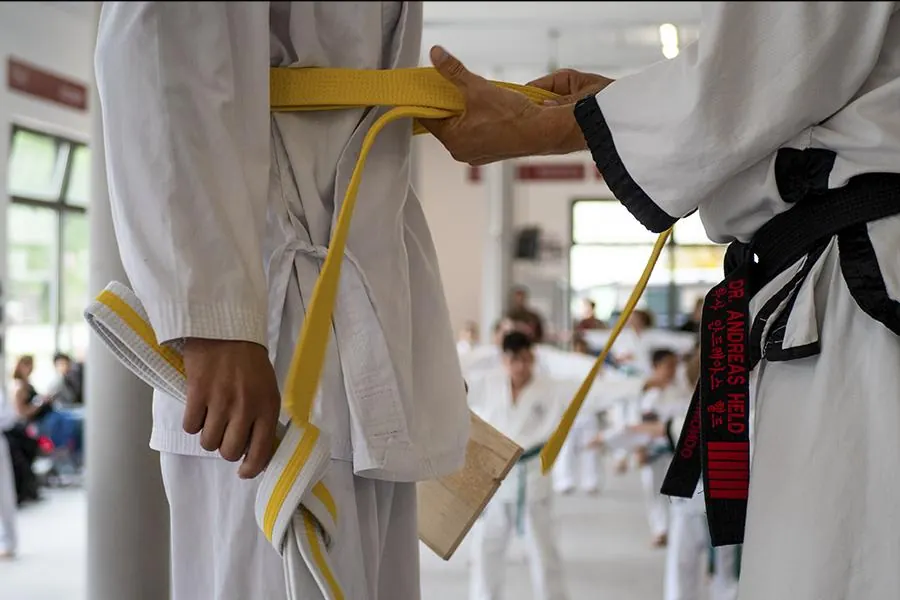
The grading system in Taekwondo is an educational tool that teaches patience, sets goals, and reflects personal maturity. In tradition, it is said: "The belt doesn't just hold up your pants; it holds the soul of the martial art together."
The Geup Ranks: The Stages of Learning
Before a student reaches the black belt, they progress through the Geup ranks (student ranks), starting from the 10th Geup (white) up to the 1st Geup. These stages carry a deep psychological component.
The Symbolism of Colors
White & Yellow (The Beginning): This phase is characterized by enthusiasm for learning basic motor skills and developing new bodily coordination.
Green & Blue (Development): Here, techniques become more complex and forms grow longer. These ranks teach perseverance and develop true strength of character when overcoming learning plateaus.
Red (Maturity): As the color of danger, red warns of the need for self-discipline. The student now possesses great physical power and must learn to control it responsibly.
The Black Belt (Dan): The True Beginning
The 1st Dan is not the end of learning, but rather the moment when the study of the true martial art can begin. It is comparable to learning the alphabet in order to subsequently write novels.
The Stages of Dan Ranks
1st to 3rd Dan: Deepening of technique and initial assistance in teaching as a "seeker."
4th to 6th Dan (Sabum): Focus on instruction and philosophy, as well as taking on greater responsibility.
7th to 9th Dan (Sa-Seong): Preservation of tradition through wisdom and humility.
The "Do" in Everyday Life
Physical: Awareness of nutrition, recovery, and prevention in daily routine.
Mental: Stress resilience and finding one's inner center in difficult situations through breath control.
Social: Courtesy towards fellow human beings and standing up for the weaker.
Lifelong Learning
Traditional Taekwondo can be practiced into old age. As youthful explosiveness fades, efficiency, precision, and spiritual depth take its place. The pursuit of constant improvement makes life rich and meaningful.
Closing Words: Your Invitation to the Path
Taekwondo is a gift to oneself – the decision to become a little better every day. It is a path that never ends, where standing back up after a defeat remains the most important technique. It is life itself in motion.
Health, Anatomy & The Impact on the Body
Traditional Taekwondo is not just a combat sport, but a highly efficient full-body workout. From a sports science perspective, this martial art engages almost all muscle groups, promotes neural connectivity, and serves as an excellent preventive measure against modern diseases of civilization.
Functional Anatomy
In Taekwondo, there are no isolated movements. A punch does not solely use the triceps, and a kick does not solely rely on the quadriceps. The entire body works as a kinetic chain.
Core Stability (The Center)
The center of power in Taekwondo is the Dan-Jun. The deep abdominal and back muscles stabilize every rotation and every kick. A strong "core" protects the spine from shear forces and prevents long-term back pain.
The Leg Chain
The training taxes the entire chain from the ankle joint through the calves up to the gluteus maximus. The abductors in particular are strengthened by side kicks, which massively improves overall hip stability in daily life.
Flexibility: More Than Just the Splits
Traditional flexibility is complex and encompasses static stretching to lengthen tendons, dynamic flexibility for explosive kicks, as well as joint mobility. This promotes the flow of synovial fluid and acts as active anti-aging for the entire musculoskeletal system.
Cardiovascular & Metabolism
The training often functions as high-intensity interval training (HIIT). The alternation between peak exertion and controlled recovery ensures an enormously high calorie burn and strengthens the heart by improving capillarization down to the smallest vessels.
The Neural Level
The complex forms and balance requirements promote the neuroplasticity of the brain. Through proprioception, the practitioner learns to perceive their body precisely in space, while the nervous system is trained to transmit signals faster from the brain to the muscles.
Psychosomatic Effects
In a world of digital sensory overload, Taekwondo offers a valuable monotasking experience. Powerful exhalation (Kihap) reduces cortisol levels, while the deep focus on movement sequences guides the mind into the "here and now."
Prevention & Regeneration
Due to its clear structure, traditional Taekwondo is increasingly recommended as a supportive activity for ADHD, for osteoporosis prevention, as well as for maintaining motor control in Parkinson's disease.
Conclusion on Health
Traditional Taekwondo is an investment in your own health. It does not wear a person down, but keeps them flexible, resilient, and mentally alert into old age. It represents the perfect symbiosis of martial arts and holistic health theory.